I started
working with the Dutch Broadcasting Foundation (NOS) in 1973 as an assistent
"program engineer radio" as we call it. After I and 8 others were
selected, there was first a business training of 6 months, because the tasks
I had to do are very specific for radio broadcasting. This training was
in Hilversum in a former restaurant, "Santbergen", the NOS had
bought for this purpose. Today it's called the "Media Academy".
I was an assistant from
1973 to 1976. As an assistent I worked in many studios to place microphones
in the orchestras and go to theatres all over the country to assist in the
recording of radio programs and concerts.
This was a great time, because I went to concerts of Ella Fitzgerald and Joe
Pass, The Steve Miller Band, Charles Aznavour and many others. But also
classical concerts, for instance in the famous Concertgebouw in Amsterdam.
Unfortunately I don't have any photographs of these years.
As an engineer I worked for
all broadcasting associations, like the AVRO (general), KRO (Catholic), NCRV
(protestant), VARA (Social-democratic), VPRO (social criticism), TROS
(general), NOS and in later years EO (evangelical) and VERONICA (general).
There were (and are) also a great number of small broadcasters. But none of
the non-commercial broadcasters have their own technicians. They hired us
(for free) from the NOS. The way the radio and television in my country works
is very hard to explain, so I won't try it.
|
Although I was not musically
active at that time, I learned about music scoring. I heard a musician
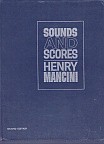
(Tony Eyk) talk about a book he bought: "Sounds and Scores" by
Henry Mancini. I also bought the book and learned about instruments and
what you can do with them in an orchestra. I even did some arranging
myself.
A colleague of mine wanted to sing a greek song, a nice 5/4. I think it was
called "Ena Karavi" and I made an arrangement. He did sing it,
but I have never heard it.
|
|
I also
arranged something else and I wanted to know how the saxophone-part would
sound. So I asked Piet Zonneveld, at the time conductor of the orchestra of
the KRO-program "Van Twaalf tot Twee", if the saxgroup could play
this for me. And they did and they were very serious about it too. Great
guys! Leader of the saxophone group was Karel Reys, brother of Rita Reys a famous
Dutch jazz-singer. He gave me some advice too about the key and range of the
saxophones. Saxophones just don't sound nice when they have to pitch very
high - this is something I take into consideration now when I play a sampled
saxophone sound on a keyboard.
|
In 1976 I became programm
engineer B. Back to "Santbergen" to learn editing. That was a
whole other kind of work. Now I had to do montage work for news-programms.
Later on all kind of other programms, like documentaries.
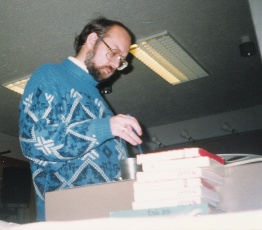
Now, my aim was to become
a programm engineer specialised in music production. But when I was
promoted to programm engineer A and did all kinds of programms, except
music recording and mixing, I kinda liked it. Especially montages with
music. Also documentaries were very nice to make, although that came after
a view years.
|
|
Before
that all happened, I started making a montage for myself in 1976 as an
assignment for myself after I finished my training. I called it "Muzikollage" which is comprised of the
words "muziek" (music) and "collage". The idea was to
make an arrangement using music on records. So I could manipulate the music
on records the way I wanted. Sometimes I only used a few seconds of a
particular record to use as a bridge between to other records. Some songs
were used a bit longer, spinned up or down and even looped and partly
reversed.
I only used tape, a tape-spinner (speedcontrol) and an effectunit
(reverb-delay). I made two programs, each about 40 minutes long and it took
me 3 years to make it (in my spare time) and I bought a lot of records during
that time. One of those programs was actually aired in 1980 in a program
called "Rauhfaser".
I like to put a few fragments on this site without further explanation. There
are 8 fragments, 4 from each montage I made. If you click on
"Muzikollage 1", you can see a description of a part of Muzikollage
1.
Disclaimer: it is not my
intention of publishing other peoples music on the internet. These are
however fragments of existing records, edited in different ways. I merely
want to show what you can do with arranging existing music.

|
|
During these years (from 1978) a
group was formed by a few engineers of the NOS. We called ourselves the PT-Band. (PT stands for Program
Technicians). We even played on two radioshows: one (live) for the
VARA ("Stoomradio") and a recorded show for the TROS (Toer ja,
Toer nee).
(Click the pictures to get to
the photopage)
|
|
But
most of the time we were just playing for ourselves and rehearsed in a studio
that was available at the time. Mostly we played in the old VARA-studio, now called the MCO, Music Centre
of the "Omroep".(Broadcast system).
|
|
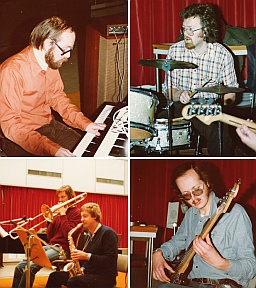
On this photo you can see the
members of the PT-band we started with. Later on there were three more
members.
Drums: Hugo Vogel
Bass : Paul Schoenmakers
Trombone: Bert van Dijk
Tenorsax: Ruud Kars
Keyboards: Herco de Boer.
We rehearsed on Tuesday
evening. The idea was that we would come together and start jamming. I
decided to write a not too difficult peace, and I called it "Tuesday
Evening Session". If you click the picture you can hear that tune, but
with the newer formation.
|
|
|
|
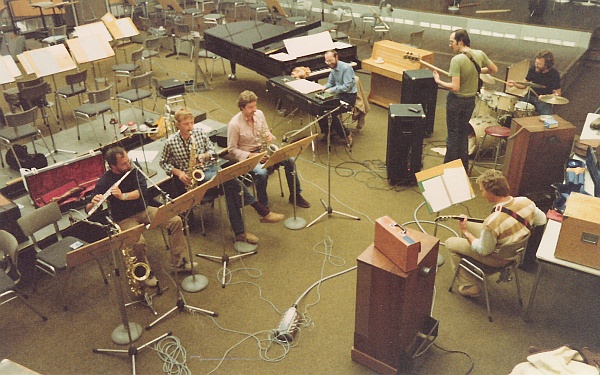
Here, in studio 8, you
see all the members of the PT-band except trombone player Bert van Dijk.
From left to right: Ferry Sluyter,
Jan Stellingwerf,
Ruud Kars, Herco de Boer, Paul Schoenmakers, Hugo Vogel and Peter van den Hoogen.
|
|